
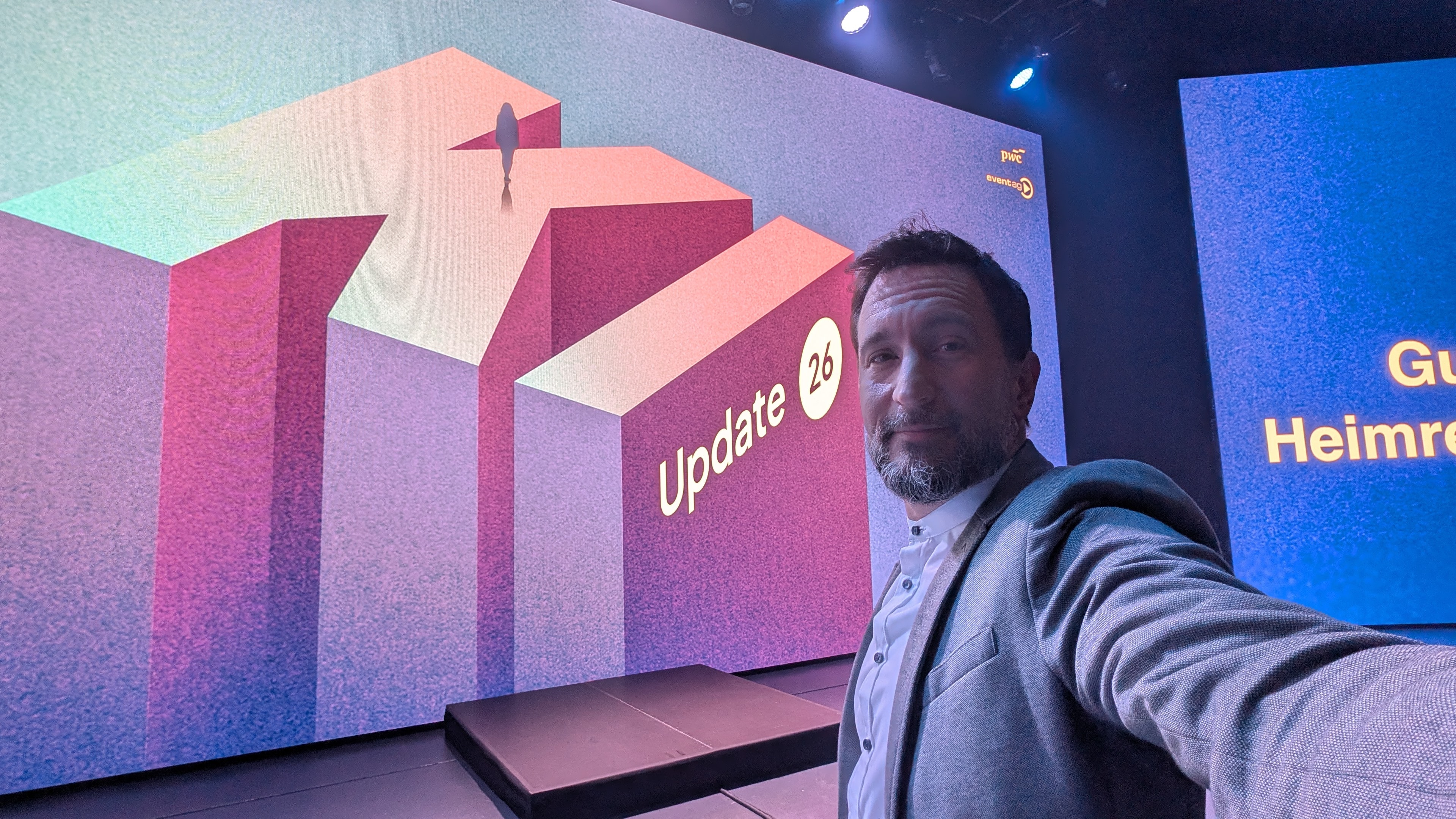
A real mental challenge
The schedule was packed. In my opinion, it was too packed. Four back-to-back presentations per session were quite a load. I would have liked a little more variety and, above all, more time for networking. After all, it’s often during the breaks that the most valuable conversations take place.
The question that came to mind as I looked around the room was obvious. Has it really sunk in among this leadership audience that AI is going to change everything? A glance at the “Firstmark 2025 MAD Landscape” (Machine Learning, AI, Data) that was presented highlighted the sheer complexity of the ecosystem. Numerous speakers did a good job of explaining this. But it will likely take much more for this message to truly reach the executive suite.
My biggest question, personally: What exactly is an agent?
A key topic was agentic AI. Here, I noticed a personal discrepancy. In discussions with the participants—including several swissAI members—it became apparent that the term “autonomous” is difficult to define.
The simplest explanation for an AI agent that was presented was: LLM plus orchestration (instructions) plus tools.
IBM provided a concrete example of this with its "Councils" for regulatory reports. The process is strictly timed:
- Documents are being uploaded
- A process starts and creates a draft
- A "Council Review" conducted by Legal Agents (using specific prompts) checks the content
- The final review is performed by a person
The result is a 70 percent savings. Is that autonomous? No. Is it useful? Absolutely. Frederico Patota of Google also referred to a Gemini Gem as an agent, even though there is no autonomous action taking place here.
Personally, I prefer to go by the definition provided by Dario Amodei, the CEO of Anthropic. To me, an agent makes autonomous decisions. Is simply choosing from a selection of software options already considered autonomous? Hardly. On the other hand, we all classify deep research tasks performed by AI systems as agentic. That’s a question we still need to clarify within the industry.
Data, Leadership, and the Chief Question Officer
Despite the confusion over terminology, the content was compelling. One sentence in particular stuck with me: AI fails because of data and leadership, not because of algorithms.
Marc Holitscher of Microsoft summed it up: We need a better work experience for employees, relevant value for customers, and we must rethink processes to scale innovation. He even introduced a new title: the CQO—Chief Question Officer. The ability to ask the right questions is becoming a core competency.
Bossard took a very pragmatic approach to addressing this from a cultural perspective.
- Define the responsible parties
- Organize an "AI Coffee" to break down barriers
- Define an Extended Team
- Form an Ethics Council
- Establish experimentation ("We experiment") as a principle
IBM also made a strategic distinction between two types of integration. On the left is broad, enterprise-wide integration; on the right are specific use cases. Both have their place, but must be managed differently.
Prafull Sharma of PwC Switzerland provided the raw data on this. 54% of CEOs are concerned about the pace of change. But only 5% believe that ROI can even be measured. At the same time, 42% of Swiss CEOs expect this to affect junior-level hiring. This creates a huge area of tension.
The Society of Meaning
The most impressive part, by far, came from Richard David Precht. He was, as usual, eloquent, direct, and witty. His thesis gives us food for thought. We are transforming from a work-oriented society into a meaning-oriented society. Routine mental work will decline. This is actually a dream of humanity. The problem is, we are completely unprepared for it.
Precht warned against “techno-feudalism,” in which tech giants assume the role of feudal lords. And he reminded us of something important: An AI can fake emotions, but it will never truly feel. When humans are bored, imagination takes hold. An AI knows no boredom. When the world’s knowledge becomes universally available, schools will have to be restructured to focus on personal development.
My Conclusion
Technology has never been neutral, as Cornelia Diethelm said. In my view, this is because there is no truly non-profit research that can prevail against commercial interests. Perhaps an open-source model like Apertus could offer this neutrality.
Those who use AI correctly will improve. Those who ignore it or use it incorrectly will fall behind. Or to put it bluntly: The stupid will get stupider, as Prafull Sharma said.
There’s one thought in particular I’m taking away from today, thanks to Richard David Precht. Let’s be kinder to ourselves again. Otherwise, ChatGPT will eventually be the only thing that treats us as politely and understandingly as we’d like to be treated.
This text was generated using AI from summaries of Instagram Stories, handwritten notes, photos, and live news coverage, and was edited by me personally. This made it possible for the post to go live on the same day.